Save 20% on your first session!

10-Minute Home Exercise Routine for Sciatica Pain Relief
Ease sciatica pain at home with our expert-guided 10-minute exercise routine. Physiotherapist-approved stretches for safe, natural sciatica pain relief.
PHYSIOTHERAPY
Shrutika
6/20/202613 min read
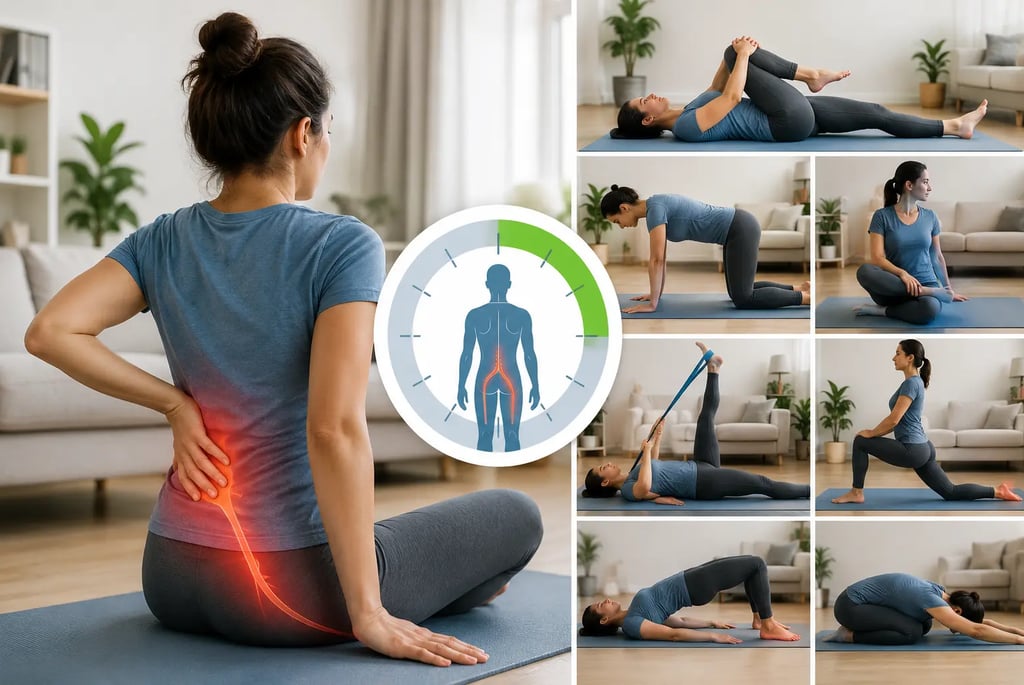
If you have ever felt a sharp, burning sensation shoot down your leg — starting somewhere in your lower back and travelling all the way to your foot — you will know exactly how debilitating sciatica can be. It is one of those conditions that does not just hurt; it disrupts your sleep, your work, and even your ability to sit comfortably for five minutes.
The good news? You do not have to simply put up with it. Targeted movement is one of the most evidence-backed approaches for achieving genuine Sciatica Pain Relief — and you do not need a gym, expensive equipment, or an hour to spare. A consistent, well-chosen 10-minute daily routine can make a meaningful difference to how you feel, day to day.
In this guide, our physiotherapists at Movement with Physios walk you through exactly what sciatica is, why the right exercises help, and — most importantly — a simple, safe, step-by-step home routine you can begin today.
What Is Sciatica and Why Does It Cause Pain?
Sciatica is not a diagnosis in itself — it is a symptom. Specifically, it describes pain that radiates along the path of the sciatic nerve, which is the longest and widest nerve in the human body. It runs from the lower back, through the hips and buttocks, and branches down each leg.
When something compresses or irritates this nerve, you feel it — often quite dramatically. The most common culprits include:
A herniated or 'slipped' disc pressing against the nerve root
Lumbar spinal stenosis — a narrowing of the spinal canal
Piriformis syndrome — where the piriformis muscle in the buttock tightens around the nerve
Degenerative disc disease associated with ageing
Spondylolisthesis — when one vertebra slips forward over another
Common symptoms of sciatica include:
A sharp, electric, or burning pain along the lower back and leg
Tingling or pins-and-needles sensations in the leg, foot, or toes
Muscle weakness in the affected leg
Pain that worsens with prolonged sitting or certain movements
Numbness along the sciatic nerve path
It is worth knowing that sciatica often affects one side of the body at a time. Bilateral sciatica — affecting both legs — is less common and warrants urgent medical review.
Can Exercise Help with Sciatica Pain Relief?
It may feel counterintuitive to move when you are in pain, but research consistently supports gentle, targeted exercise as one of the most effective tools for managing sciatica. Complete rest was once recommended — we now know that prolonged inactivity can actually worsen symptoms.
Here is why movement works:
It reduces inflammation by improving circulation around the affected nerve.
It helps restore normal movement patterns and reduces muscle tightness that can compound nerve compression.
It strengthens the core and lumbar muscles that support the spine.
It encourages the release of endorphins — the body's natural pain-relieving chemicals.
It prevents the muscular deconditioning that tends to happen when people avoid activity out of fear of pain.
That said, not every exercise is suitable for every person with sciatica. Because the underlying cause varies, some movements that help one person may aggravate another. This is why physiotherapy-guided exercise selection — tailored to your specific presentation — is so important (more on this later).
Benefits of a 10-Minute Daily Routine for Sciatica
You might wonder whether ten minutes is really enough to make a difference. The answer — for many people in the early to moderate stages — is yes, if the exercises are performed correctly and consistently.
A short, daily routine offers several distinct advantages:
Consistency: A manageable commitment is one you will actually stick to.
Reduced flare-up risk: Short, gentle sessions are less likely to aggravate symptoms than longer, more intense workouts.
Cumulative benefit: Daily movement gradually loosens tight muscles and improves nerve mobility.
Improved posture awareness: Regular movement helps you tune into how you hold your body throughout the day.
Mental wellbeing: Chronic pain has a psychological toll; doing something proactive each morning sets a positive tone.
Things to Remember Before Starting Sciatica Exercises
⚠️ Important: If you are currently experiencing severe pain, loss of bladder or bowel control, or significant leg weakness, please stop and contact a healthcare professional immediately. These symptoms may indicate a more serious condition requiring urgent attention.
Before you begin your routine, keep these principles in mind:
Never push through sharp or worsening pain. Mild discomfort can be normal; sharp or shooting pain is your signal to stop.
Move slowly and mindfully. This is not a workout for speed; quality of movement is everything.
Breathe continuously throughout each exercise. Holding your breath increases tension and can worsen discomfort.
Use a yoga mat or soft carpet for floor-based exercises.
Wear comfortable, non-restrictive clothing.
Aim to perform this routine once daily — morning is ideal for most people as it helps ease overnight stiffness.
If symptoms change or worsen significantly, book an assessment with a physiotherapist.
10-Minute Home Exercise Routine for Sciatica Pain Relief
This routine has been designed by our physiotherapy team at Movement with Physios. It progresses from gentle mobility work through to targeted stretching for the structures most commonly involved in sciatica. Perform each exercise in sequence, without rushing.
1. Pelvic Tilts (1 Minute)
Why it helps: Pelvic tilts gently mobilise the lumbar spine and activate the deep core stabilisers. They reduce stiffness around the lower back and create space in the lumbar vertebrae, which can help relieve pressure on compressed nerve roots.
Step-by-step instructions:
Lie on your back with your knees bent and your feet flat on the floor, hip-width apart.
Let your lower back rest in its natural position — there will be a small gap between your spine and the floor.
Breathe in to prepare. As you exhale, gently press your lower back into the floor by engaging your abdominal muscles and tilting your pelvis slightly upward.
Hold for 3–5 seconds, then inhale and allow the back to return to its natural arch.
That is one repetition. Perform 10–15 repetitions.
Duration and repetitions: 10–15 reps over approximately 1 minute.
Breathing: Exhale as you flatten your back; inhale as you release.
Safety tip: Keep the movement small and controlled. This is not a bridge — your hips should stay on the floor throughout.
Common mistake: Overarching the back on the release phase, which can aggravate lumbar symptoms. Keep the range of motion gentle and symmetrical.
2. Knee-to-Chest Stretch (1 Minute)
Why it helps: This stretch decompresses the lumbar spine and gently lengthens the lower back extensors. It also reduces tension in the hip flexors and gluteal muscles — areas that commonly contribute to sciatic nerve irritation.
Step-by-step instructions:
Lie on your back with both knees bent and feet flat on the floor.
Gently bring one knee towards your chest, holding the back of your thigh (not the knee itself) with both hands.
Hold the stretch for 20–30 seconds, breathing normally throughout.
Slowly lower the leg and repeat on the opposite side.
Perform 2–3 repetitions on each side.
Duration and repetitions: 20–30 second holds, 2–3 reps each side, approximately 1 minute.
Breathing: Breathe slowly and deeply throughout; try to release a little further into the stretch on each exhale.
Safety tip: Avoid pulling on the knee joint directly. Always hold the thigh or shin to protect the knee.
Common mistake: Raising the head and neck off the floor, which creates unnecessary tension in the upper body. Keep your head relaxed against the mat.
3. Cat-Cow Stretch (2 Minutes)
Why it helps: Cat-Cow is a classic spinal mobility exercise that moves the spine through flexion and extension. It improves circulation to the intervertebral discs, reduces lumbar stiffness, and gently mobilises the nerve roots — making it particularly beneficial for disc-related sciatica.
Step-by-step instructions:
Come onto all fours with your wrists directly beneath your shoulders and your knees beneath your hips. Your spine should be in a neutral position — not arched or rounded.
Cow Pose (Inhale): As you breathe in, gently let your belly drop towards the floor, lift your chest and tailbone, and allow a natural arch in your lower back.
Cat Pose (Exhale): As you breathe out, round your spine upward toward the ceiling, tuck your chin to your chest, and draw your tailbone under.
Move slowly and fluidly between the two positions, allowing your breath to guide the movement.
Perform 10–12 full cycles over approximately 2 minutes.
Duration and repetitions: 10–12 complete breath cycles over 2 minutes.
Breathing: Inhale during Cow; exhale during Cat. Never hold your breath.
Safety tip: If Cat Pose (the rounded back position) increases leg pain, reduce the range of that phase and stay closer to neutral.
Common mistake: Moving too quickly and losing the breath connection. Slow movement is far more therapeutic than a rapid, mechanical rocking motion.
4. Seated Piriformis Stretch (2 Minutes)
Why it helps: The piriformis muscle sits deep in the buttock, close to the sciatic nerve. When it becomes tight or overactive — as it often does in sedentary individuals or runners — it can directly compress the nerve. Stretching it regularly is a key component of sciatic nerve pain relief exercises.
Step-by-step instructions:
Sit upright on a firm chair with your feet flat on the floor.
Cross your right ankle over your left knee, allowing your right knee to fall outward. Your shin should be roughly horizontal.
Sit tall and gently hinge forward from your hips — not your waist — until you feel a stretch deep in your right buttock.
Hold for 20–30 seconds, breathing steadily.
Return to sitting upright and repeat on the left side.
Perform 2 repetitions on each side.
Duration and repetitions: 20–30 second holds, 2 reps each side, approximately 2 minutes.
Breathing: Inhale to sit tall; exhale as you lean forward to deepen the stretch.
Safety tip: If you feel tingling or increased numbness during this stretch, ease out of it and consult a physiotherapist. This may indicate that piriformis syndrome is not your primary issue.
Common mistake: Rounding the lower back as you lean forward. Keep your spine long and the movement coming from your hip crease, not your lumbar area.
5. Hamstring Stretch (2 Minutes)
Why it helps: Tight hamstrings are one of the most underappreciated contributors to sciatica symptoms. When the hamstrings are shortened, they pull on the pelvis and increase stress on the lumbar spine. Stretching them gently also helps glide the sciatic nerve, reducing neural tension along its full length.
Step-by-step instructions (Supine version — preferred for sciatica):
Lie on your back with both knees bent.
Bring one knee toward your chest, then extend the leg toward the ceiling as comfortably as possible. Hold the back of your thigh with both hands.
Gently flex your foot — pulling the toes towards you — to increase the nerve stretch.
Hold for 20–30 seconds. You should feel the stretch along the back of your thigh and possibly down into the calf.
Slowly lower the leg and repeat on the opposite side.
Perform 2 repetitions on each leg.
Duration and repetitions: 20–30 second holds, 2 reps each leg, approximately 2 minutes.
Breathing: Breathe slowly throughout; try to relax the leg muscles on each exhale to allow the stretch to deepen gradually.
Safety tip: Do not force the leg to straighten. Work within your available range. If the stretch provokes significant shooting pain down the leg, reduce the range or skip this exercise and speak to a physiotherapist.
Common mistake: Holding the foot or ankle with a straight arm, which engages the upper body unnecessarily. Keep the hands at the thigh and let the hip be the anchor point.
6. Child's Pose (2 Minutes)
Why it helps: Child's Pose is a restorative position that gently lengthens the entire posterior chain — the lower back, the gluteal muscles, and the lumbar paraspinals. It creates traction through the lumbar spine and allows the nervous system to calm down. It is an ideal way to finish your routine.
Step-by-step instructions:
Begin on all fours. Bring your big toes together and widen your knees to approximately hip-width apart (or wider if more comfortable).
Sit your hips back towards your heels — as far as is comfortable.
Walk your hands forward on the floor and allow your forehead to rest on the mat.
Let your arms rest alongside your body (relaxed version) or extend forward with palms down (active version). Either is fine.
Breathe deeply into the back of your ribcage, feeling your lower back gently expand with each inhale.
Hold for 1–2 minutes, letting gravity do the work.
Duration and repetitions: Hold for 1–2 minutes continuously.
Breathing: This is a breathwork exercise as much as a stretch. Try 4 counts in through the nose and 6 counts out through the mouth — this activates your parasympathetic nervous system and amplifies pain relief.
Safety tip: If your hips cannot reach your heels, place a folded blanket or pillow between your thighs and calves for support. Avoid forcing the position.
Common mistake: Rushing through Child's Pose as if it is just a transitional position. Give it the full time — the restorative benefits accumulate over sustained holds.
Exercises to Avoid If You Have Sciatica
Just as some movements provide relief, others can significantly aggravate sciatic symptoms. Until you have had a proper assessment, it is generally advisable to avoid the following:
Heavy deadlifts and barbell squats: These load the lumbar spine under high compression and can worsen disc-related sciatica.
Sit-ups and double-leg raises: These increase intra-abdominal pressure and place significant strain on the lumbar vertebrae and discs.
Forward bends with straight legs (toe touches): These create high tension along the sciatic nerve and can provoke or worsen symptoms.
High-impact exercise (running, jumping): Particularly during a flare-up, the jarring forces can aggravate an already sensitised nerve.
Leg press machine with heavy weight: Placing the feet high on the platform in deep hip flexion can compress spinal structures significantly.
Prolonged sitting on soft surfaces: While not an exercise, this is a common trigger. Hard, supportive seating is better for most people with sciatica.
If you are unsure whether a specific activity is safe for your situation, always ask your physiotherapist before attempting it.
When Should You See a Physiotherapist for Sciatica?
Home exercises are a powerful first step — but they are not a substitute for professional assessment. You should seek physiotherapy advice if:
Your pain has not improved after 4–6 weeks of consistent home exercise.
Your symptoms are getting progressively worse despite rest and gentle movement.
You experience any loss of bladder or bowel control — this requires emergency medical attention.
You have significant weakness in a leg or foot (for example, difficulty lifting the foot when walking).
You are unsure what is causing your sciatica, as the wrong exercises can worsen certain causes.
Your pain is severe enough to interfere significantly with sleep or daily activities.
You have recently been involved in an accident or fall that preceded the onset of symptoms.
Our Physiotherapy Services at Movement with Physios include a comprehensive initial assessment to identify the root cause of your sciatica before designing your personalised rehabilitation plan.
Why Professional Assessment Matters for Sciatica
Key insight: Sciatica is not a one-size-fits-all condition. Two people with the same symptom pattern may have completely different underlying causes — and what helps one person may harm another. This is why individual assessment is essential.
A qualified physiotherapist will assess:
The exact level of nerve root involvement through neurological testing
Muscle strength and flexibility imbalances contributing to the problem
Your posture and movement patterns under load
Lifestyle and occupational factors that may be perpetuating symptoms
Whether your sciatica is disc-related, piriformis-related, or caused by spinal stenosis — each requires a different approach
At Movement with Physios, our team draws on a range of evidence-based treatment tools alongside exercise rehabilitation, including Manual Therapy, Dry Needling Therapy, and Posture Correction Treatment — each deployed based on what your specific presentation demands.
For those who have sustained their injury in a sporting context, our Sports Injury Rehabilitation programme integrates sciatica management with safe return-to-sport planning.
How Physiotherapy Helps with Long-Term Sciatica Pain Relief
Physiotherapy for sciatica is about more than temporary symptom relief. A well-structured programme addresses the underlying causes and builds the resilience your body needs to prevent recurrence.
Long-term physiotherapy management typically includes:
Neural mobilisation techniques to restore healthy movement of the sciatic nerve through its surrounding tissues
Progressive core strengthening to improve spinal stability and reduce load on the affected disc or joint
Manual therapy and joint mobilisation to address stiffness in the lumbar and sacroiliac joints
Soft tissue release to muscles such as the piriformis, gluteus medius, and lumbar paraspinals
Ergonomic advice to reduce provocative postures at work and at home
Education about pain management strategies and activity modification
A graded return to full activity — whether that means returning to sport, lifting at work, or simply being able to sit comfortably on a long flight
The evidence is clear: physiotherapy-guided exercise is more effective for sciatica than medication alone, and significantly better than passive treatments without rehabilitation. Our team at Movement with Physios is committed to getting you not just pain-free, but genuinely stronger and more resilient than before.
Frequently Asked Questions (FAQs)
1. What is the fastest way to get sciatica pain relief?
There is no single 'fastest' fix, as the right approach depends on what is causing your sciatica. That said, most people find that a combination of gentle targeted movement (such as the routine in this article), anti-inflammatory measures (ice or heat, as appropriate), and avoiding prolonged sitting provides the quickest symptomatic relief. For faster resolution of the underlying problem, a physiotherapy assessment is the most efficient route.
2. Can I exercise every day with sciatica?
Yes — in most cases, gentle daily exercise is encouraged and beneficial. The key word is 'gentle'. The routine described in this article is designed to be performed daily. However, if you are having a significant flare-up with severe pain, it may be worth taking one rest day and then returning to light movement the following day. Avoid complete inactivity for more than a day or two.
3. How long does it take for sciatica exercises to work?
Many people notice a reduction in symptoms within 2–4 weeks of consistent daily exercise, though this varies significantly depending on the cause and severity of the sciatica. Disc herniations, for example, can take 6–12 weeks to resolve fully with conservative management. Consistency is more important than intensity — ten minutes every day will outperform an hour once a week.
4. Which exercise is best for sciatica pain relief?
There is no single universally 'best' exercise for sciatica because the optimal choice depends on the underlying cause. For disc-related sciatica, gentle extension exercises and nerve mobilisation are often most helpful. For piriformis syndrome, targeted hip stretching is typically more effective. The piriformis stretch and hamstring stretch in this routine address both mechanisms, which is why they feature prominently.
5. Is walking good for sciatica?
Yes — walking is generally excellent for sciatica. It encourages healthy circulation, reduces inflammation, and keeps the lumbar muscles active without excessive compressive loading. Start with short, comfortable walks (10–15 minutes) and gradually increase duration as your symptoms allow. Walking uphill may aggravate some presentations; flat terrain is preferable during a flare-up.
6. Can physiotherapy cure sciatica?
In many cases, physiotherapy can effectively resolve sciatica entirely — particularly when the cause is muscular imbalance, a mild disc herniation, or piriformis syndrome. Physiotherapy is unlikely to 'cure' a more severe spinal stenosis in the same way, but it can significantly reduce symptoms and improve quality of life. Your physiotherapist will give you a realistic prognosis based on your individual presentation.
7. What should I avoid when I have sciatica?
Avoid prolonged sitting without movement breaks (aim to stand or walk every 30 minutes), heavy lifting with a flexed spine, high-impact activities during flare-ups, and any position or movement that consistently reproduces your shooting leg pain. Sleeping on your side with a pillow between your knees is often more comfortable than lying on your back or stomach.
Start Your Journey Towards Pain-Free Movement
Living with sciatica is exhausting — but it does not have to be permanent. The 10-minute routine in this guide is a solid, evidence-informed starting point. Practised consistently, it can meaningfully reduce pain, improve your mobility, and help you reclaim the activities that matter to you.
At the same time, we want to be honest with you: home exercises are one important piece of the puzzle. For lasting results — particularly if your symptoms are severe, persistent, or worsening — nothing replaces a thorough, one-to-one physiotherapy assessment. The underlying cause of your sciatica matters enormously, and the right treatment plan looks different for every person.
Do not let pain become the background noise of your life. The sooner you address it with the right support, the better your outcomes are likely to be.
Ready to Move Without Pain?
At Movement with Physios, our expert physiotherapists provide personalised assessment and evidence-based treatment plans for effective Sciatica Pain Relief. If your pain is affecting your daily activities, contact us today and start your journey towards pain-free movement.
📞 Book Your Assessment: www.movementwithphysios.com
This article is written for informational purposes only and does not constitute medical advice. Always consult a qualified physiotherapist or healthcare professional for personalised guidance.
Contact:
1st floor, Noida Indoor Stadium,
Sector 21A, Noida,
Uttar Pradesh 201307
Phone:
info@movementwithphysios.com
© 2026 Movement With Physios. All rights reserved.
Email:
Movement With Physios offer professional physiotherapy services guided by clinical expertise, modern rehabilitation techniques, and a patient-centered approach; ensuring safe, effective, and reliable care at every stage of recovery.