
That sharp, nagging ache on the outside of your elbow — it shows up when you lift your coffee mug, shake someone's hand, or try to open a car door. If this sounds familiar, you might be dealing with tennis elbow.
The good news? You do not need surgery. Tennis elbow physiotherapy treatment has helped thousands of people — from office workers and gym enthusiasts to cricket players, badminton players, and carpenters — recover fully and get back to doing what they love.
In this guide, the expert team at Movement with Physios shares everything you need to know about tennis elbow: what causes it, how it is diagnosed, and what evidence-based physiotherapy rehabilitation looks like from day one to full recovery.
Whether your pain started last week or has been bothering you for months, this article will give you a clear roadmap to healing.
Book Your Tennis Elbow Assessment at Movement with Physios — Noida's Trusted Physiotherapy Clinic
What Is Tennis Elbow (Lateral Epicondylitis)?
Tennis elbow, medically known as lateral epicondylitis, is a painful condition that affects the tendons on the outer side of your elbow. These tendons connect your forearm muscles to the bony bump on the outside of your elbow, called the lateral epicondyle.
When you repeatedly use your wrist and forearm — gripping, twisting, lifting — those tendons get overloaded. Over time, tiny tears develop in the tendon tissue. This causes inflammation, pain, and weakness.
Despite its name, you do not have to play tennis to get tennis elbow. In fact, most patients we see at Movement with Physios are office workers, gym-goers, and people in trades like plumbing, carpentry, and cooking.
Quick Facts About Tennis Elbow
• Affects 1–3% of the general population each year
• Most common in people aged 35–55
• Dominant arm is affected in 75% of cases
• Can resolve with proper physiotherapy in 80–90% of cases — no surgery needed
• Average recovery: 6–12 weeks with consistent rehab
What Causes Tennis Elbow?
Tennis elbow does not usually happen overnight. It builds up over time due to repeated stress on the forearm tendons. Here are the most common causes:
1. Repetitive Strain and Overuse
Any activity that involves repetitive wrist extension or gripping can lead to tendon damage. This is the most common cause of lateral epicondylitis. The tendon does not get enough time to recover between sessions, causing micro-tears to accumulate.
2. Sports Activities
Racket sports like tennis, badminton, and squash put a significant load on the forearm muscles — especially with poor technique or an ill-fitting grip. Overhead throwing sports and weightlifting can also contribute to elbow pain and repetitive strain injury.
3. Office Work and Prolonged Typing
Typing for long hours with poor wrist posture, heavy mouse usage, and awkward workstation setup are increasingly common causes. This is one of the biggest reasons we see so many IT professionals and desk workers seeking elbow pain physiotherapy.
4. Improper Lifting Techniques
Lifting objects with the wrist bent or the palm facing down overloads the wrist extensor tendons. This is common in gyms, warehouses, and construction sites where form is often overlooked.
5. Poor Biomechanics
Tight shoulder muscles, poor scapular control, or weakness in the rotator cuff can force the forearm and elbow to compensate. Over time, this chain reaction leads to tendon overload at the elbow.
6. Occupational Causes
Carpenters, plumbers, electricians, painters, butchers, and chefs — any occupation that requires repetitive arm movements, gripping tools, or twisting motions — carries a higher risk. These occupational injuries often become chronic if not treated early.
Common Symptoms of Tennis Elbow
Not sure if what you are feeling is tennis elbow? Here are the most common signs to watch for:
Pain on the outside of the elbow — the defining symptom. It may start as a dull ache and worsen with activity.
Weak grip strength — difficulty holding objects, especially with the arm extended.
Difficulty lifting objects — even something as light as a cup of tea can trigger pain.
Pain while shaking hands — the act of gripping and rotating the wrist is painful.
Forearm tenderness — the muscles running from the elbow down to the wrist feel sore to touch.
Pain during wrist extension — trying to bend your wrist upward (toward the back of your hand) causes discomfort.
Pain worsens at night — in some cases, throbbing elbow pain can disturb sleep.
Stiffness in the morning — the elbow and forearm feel tight after rest.
When to Seek Help Immediately
If you experience sudden intense swelling, numbness, tingling down the fingers, or complete loss of grip strength, see a physiotherapist or doctor promptly. These symptoms may indicate a more serious injury requiring a detailed differential diagnosis.
How Physiotherapists Diagnose Tennis Elbow
At Movement with Physios, we conduct a thorough clinical assessment before designing your treatment plan. Here is how we diagnose tennis elbow:
Clinical Examination
Our physiotherapist will take a detailed history — when the pain started, what makes it better or worse, your daily activities and job demands. A hands-on examination of the elbow, forearm, and surrounding structures follows.
We use specific clinical tests such as the Cozen's Test, Mill's Test, and Maudsley's Test to confirm lateral epicondylitis and rule out other conditions.
Range of Motion Assessment
We assess how freely your elbow bends and straightens, and how well your wrist moves in all directions. Restrictions or pain at specific angles help us pinpoint the problem.
Grip Strength Testing
Using a dynamometer, we measure how much force your grip can generate. In tennis elbow, grip strength on the affected side is typically reduced — sometimes by 30–40% compared to the healthy arm. This objective measure also helps us track your progress over time.
Functional Assessment
We watch you perform daily tasks and sport-specific movements. This reveals how the injury affects your real-world function and helps us tailor exercises accordingly.
Differential Diagnosis
Several other conditions can mimic tennis elbow — radial tunnel syndrome, posterior interosseous nerve compression, cervical radiculopathy (neck nerve issues), or referred pain from the shoulder. We rule these out carefully to make sure you get the right treatment.
Tennis Elbow Physiotherapy Treatment: Evidence-Based Rehab Approach
Our approach to tennis elbow physiotherapy treatment at Movement with Physios is built on the latest clinical research. We do not believe in a one-size-fits-all solution. Instead, we combine multiple proven techniques to address your specific pain, function, and goals.
Pain Management Phase
The first priority is getting your pain under control so you can start moving and healing comfortably. Here is what this involves:
Activity Modification
We guide you on which activities to reduce or temporarily avoid — not complete rest, but smart load management. Continuing to use your arm in a pain-free range is actually important for tendon health.
Cryotherapy (Ice Therapy)
Applying an ice pack to the outer elbow for 10–15 minutes after activity reduces local inflammation and eases pain. This simple technique is highly effective in the early stages.
Taping Techniques
We use evidence-based taping methods — including Kinesiology tape and rigid sports tape — to offload stress from the tendon, provide proprioceptive feedback, and allow you to stay active with less discomfort.
Elbow Bracing
A tennis elbow counterforce brace (worn just below the elbow) redistributes force away from the damaged tendon. We assess the right type and fit for your arm.
Patient Education
Understanding what is happening in your tendon, why it hurts, and what helps it heal is powerful. Education reduces fear, improves adherence to rehab, and leads to better outcomes.
Manual Therapy
Hands-on treatment from a skilled physiotherapist can dramatically improve pain and movement. Our manual therapy techniques include:
Soft Tissue Release: Targeted pressure along the forearm muscles to release tension in the wrist extensors and relieve pain at the tendon insertion.
Myofascial Release: Working on the connective tissue surrounding the forearm muscles to improve mobility and reduce tightness.
Joint Mobilisation: Gentle movements of the elbow and wrist joints to restore full range of motion and reduce stiffness.
Trigger Point Therapy: Deactivating painful muscle knots (trigger points) in the forearm and upper arm that often refer pain to the elbow.
Related Services at Movement with Physios
→ Sports Injury Rehabilitation — For athletes recovering from tennis elbow and other sports injuries
→ Physiotherapy for Shoulder Pain — Because shoulder weakness often contributes to elbow overload
→ Physiotherapy for Neck Pain — Cervical nerve issues can refer pain to the elbow
Electrotherapy Treatments
We use advanced electrotherapy modalities to accelerate tissue healing and reduce pain:
Ultrasound Therapy
Therapeutic ultrasound delivers deep heat to the injured tendon, improving blood flow, reducing stiffness, and promoting tissue repair. It is gentle, painless, and highly effective when combined with exercise.
TENS (Transcutaneous Electrical Nerve Stimulation)
TENS sends low-level electrical impulses through electrode pads placed on the skin. It blocks pain signals and triggers the release of natural pain-relieving chemicals in the body — offering relief without medication.
IFT (Interferential Therapy)
IFT uses two medium-frequency currents that intersect in the tissue, creating a therapeutic effect deeper than TENS. It reduces swelling, eases chronic pain, and improves circulation around the elbow.
Shockwave Therapy
Extracorporeal shockwave therapy (ESWT) is one of the most evidence-supported treatments for chronic tennis elbow. It delivers acoustic energy pulses that stimulate cellular repair, break down calcific deposits, and trigger new blood vessel formation in the tendon. Studies show a 70–80% success rate for chronic cases.
→ Learn more about Shockwave Therapy at Movement with Physios
Dry Needling for Tennis Elbow
Dry needling is a highly effective technique for relieving stubborn tennis elbow pain. Our trained physiotherapists insert thin, sterile needles into specific trigger points in the forearm muscles and the tendon itself.
This stimulates local healing, releases tight muscle bands, and disrupts the pain cycle. Many patients notice significant relief within just 2–3 sessions. It is especially helpful for chronic cases where manual therapy alone has not been enough.
→ Explore Dry Needling at Movement with Physios
Exercise-Based Rehabilitation
Exercise is the cornerstone of tennis elbow rehabilitation. Research consistently shows that progressive tendon loading — done correctly and gradually — is the most effective way to restore strength, reduce pain, and prevent recurrence. Here are the key exercises we prescribe:
Exercise 1: Wrist Extensor Stretch
Purpose: Lengthens the tight forearm muscles and reduces tension on the inflamed tendon.
How to Do It: Extend your affected arm straight in front of you, palm facing down. Use your other hand to gently pull your fingers downward toward the floor until you feel a stretch along the top of your forearm. Hold for 20–30 seconds.
Reps & Sets: 3 sets × 30 seconds hold. Perform 2–3 times daily.
Common Mistakes: Avoid forcing the stretch — it should feel like a gentle pull, not pain.
Progression Tip: As pain reduces, hold for longer (up to 45 seconds) and repeat more frequently.
Exercise 2: Wrist Flexor Stretch
Purpose: Balances the forearm muscles by stretching the underside, which indirectly reduces load on the extensor tendons.
How to Do It: Extend your arm with palm facing up. Use your other hand to gently pull your fingers downward until you feel a stretch along the underside of your forearm. Hold for 20–30 seconds.
Reps & Sets: 3 sets × 30 seconds hold. Perform 2 times daily.
Common Mistakes: Do not lock your elbow aggressively — keep a soft bend.
Progression Tip: Combine with the wrist extensor stretch for a balanced forearm flexibility routine.
Exercise 3: Isometric Wrist Extension
Purpose: Activates the wrist extensor muscles without movement, making it the safest starting point for loading the tendon during the painful early phase.
How to Do It: Sit with your affected forearm resting on a table, palm facing down. Place your other hand on the back of your affected hand. Try to lift your hand upward against the resistance of your other hand, but do not allow any movement. Hold for 10–30 seconds.
Reps & Sets: 5 sets × 20–30 second holds. Daily.
Common Mistakes: Do not hold your breath. Avoid shrugging your shoulders.
Progression Tip: Progress to light eccentric loading once isometrics are pain-free.
Exercise 4: Eccentric Wrist Extension
Purpose: Eccentric exercises for tennis elbow are the gold standard in tendon rehabilitation. They stimulate collagen production and promote healing of degenerative tissue.
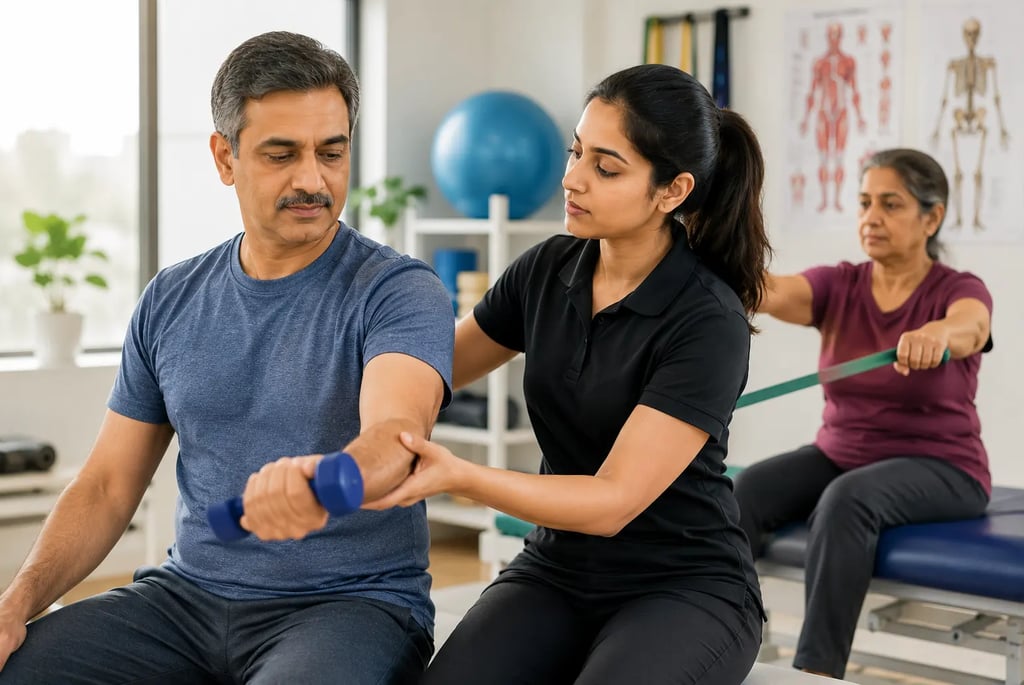
How to Do It: Hold a light dumbbell (0.5–1 kg) in your affected hand, palm facing down. Use your other hand to lift your wrist upward. Then slowly lower the dumbbell back down over 4–5 seconds using only your affected arm. That slow lowering is the eccentric phase.
Reps & Sets: 3 sets × 15 reps. Perform daily or every other day.
Common Mistakes: Do not rush the lowering phase — slow is the key to success.
Progression Tip: Gradually increase weight (0.5 kg increments) as the exercise becomes pain-free.
Exercise 5: Resistance Band Wrist Extension
Purpose: Builds functional strength in the wrist extensors using progressive resistance — ideal for the strength phase of rehabilitation.
How to Do It: Anchor a resistance band under your foot or in a door. Hold the other end in your affected hand, palm facing down. Slowly pull the band upward into wrist extension, then lower it back down with control.
Reps & Sets: 3 sets × 12–15 reps. 3 times per week.
Common Mistakes: Keep the movement controlled — avoid snapping the band.
Progression Tip: Progress from light to medium to heavy resistance bands over 4–8 weeks.
Exercise 6: Grip Strengthening
Purpose: Restores grip strength and functional hand power — both reduced in tennis elbow and essential for daily life and sport.
How to Do It: Squeeze a soft rubber ball or therapy putty as firmly as comfortable. Hold the squeeze for 3–5 seconds, then slowly release.
Reps & Sets: 3 sets × 15–20 squeezes. Daily.
Common Mistakes: Do not squeeze to the point of sharp pain at the elbow.
Progression Tip: Progress to a firmer putty or a grip strengthener device as pain allows.
Exercise 7: Scapular Strengthening
Purpose: Improving shoulder blade control reduces compensatory overload on the elbow and prevents recurrence — a step most rehab programs miss.
How to Do It: Stand tall and squeeze your shoulder blades together gently, as if trying to hold a pencil between them. Hold for 5–10 seconds, then release. Combine this with resistance band rows for added benefit.
Reps & Sets: 3 sets × 15 reps. 3 times per week.
Common Mistakes: Do not hike your shoulders up toward your ears during the exercise.
Progression Tip: Progress to single-arm rows with a resistance band or cable machine.
Exercise 8: Functional Return-to-Sport Exercises
Purpose: Prepares the elbow for the specific demands of your sport or occupation so you can return safely and confidently.
How to Do It: Mimic the exact movements of your activity — racket swings, throwing motions, typing simulation, tool gripping — starting slowly and gradually increasing speed, load, and repetitions under guidance.
Reps & Sets: Tailored to your sport or occupation. Typically 3–4 weeks before full return.
Common Mistakes: Do not rush this stage — returning too early is the number one cause of re-injury.
Progression Tip: Follow a graduated return protocol set by your physiotherapist at Movement with Physios.
4-Phase Tennis Elbow Rehab Program
At Movement with Physios, we use a structured four-phase rehabilitation program for tennis elbow. Each phase builds on the last — so nothing is rushed, and you are always progressing safely.
Phase 1: Pain Reduction (Weeks 1–2)
The focus is on calming irritated tissues. We use activity modification, cryotherapy, taping, bracing, and patient education. Gentle isometric exercises begin toward the end of this phase to start loading the tendon safely.
Phase 2: Mobility Restoration (Weeks 2–4)
Once pain is manageable, we work on restoring full flexibility and joint mobility. Stretching routines, manual therapy, and gentle range-of-motion exercises feature prominently. Electrotherapy and dry needling continue as needed.
Phase 3: Strength Development (Weeks 4–10)
This is where the real rehabilitation happens. Eccentric exercises, resistance band work, grip strengthening, and scapular stabilisation exercises progressively rebuild tendon capacity. Sessions at our clinic are spaced 2–3 times per week alongside a home exercise programme.
Phase 4: Return to Activity (Weeks 8–12+)
The final phase focuses on sport-specific or occupation-specific conditioning. We simulate the demands of your activity, correct any biomechanical faults, and build your confidence. We only sign you off when you are functionally ready — not just pain-free.
What Activities Should You Avoid During Recovery?
Knowing what to avoid is just as important as knowing what to do. During your tennis elbow rehabilitation, try to reduce or avoid:
Gripping heavy objects tightly — avoid carrying heavy shopping bags or luggage on the affected side
Repetitive wrist movements — limit typing, mouse use, or any activity that causes pain
Racket sports and throwing — until cleared by your physiotherapist in Phase 4
Gym exercises that load the forearm — bicep curls, lat pulldowns, and tricep pushdowns with heavy weight
Lifting with palm facing downward — always try to lift with your palm facing up (supinated) to reduce tendon stress
Ignoring pain — some discomfort during rehabilitation is normal, but sharp or worsening pain is a signal to stop
Golden Rule During Recovery
If an activity causes pain above 4/10 during or after the exercise, it is too much too soon. Dial back the load or movement and speak to your physiotherapist.
How Long Does Tennis Elbow Take to Heal With Physiotherapy?
Recovery time depends on how long you have had the condition, how severe the tendon damage is, and how consistently you follow your rehabilitation programme. Here is a general guide:
Mild Cases (Pain for Less Than 4 Weeks)
With early physiotherapy intervention, activity modification, and a structured exercise programme, most mild cases resolve in 4–6 weeks. Catching it early makes a huge difference.
Moderate Cases (Pain for 4–12 Weeks)
With consistent physiotherapy — including manual therapy, electrotherapy, and progressive exercises — moderate cases typically recover in 6–12 weeks. Some patients need additional treatments like dry needling or shockwave therapy.
Chronic Cases (Pain for More Than 3 Months)
Chronic tennis elbow, where the tendon has undergone degenerative changes, may take 3–6 months to fully resolve. However, with advanced treatments such as shockwave therapy and a structured eccentric loading programme, the majority of patients achieve excellent outcomes without surgery.
Research Says:
A 2023 systematic review published in the British Journal of Sports Medicine confirmed that exercise therapy — especially eccentric exercises — is the most effective long-term treatment for lateral epicondylitis, outperforming steroid injections at 6 and 12 months.
When Should You Visit a Physiotherapist?
Many people wait too long before seeking help — hoping the pain will go away on its own. Sometimes it does. But often it lingers, becomes chronic, and is much harder to treat. Visit a physiotherapist if:
Your elbow pain has lasted more than 2–3 weeks despite rest
Pain is affecting your ability to work, exercise, or perform daily tasks
You have tried home remedies but the symptoms keep returning
You notice significant weakness in your grip or forearm
You are a sportsperson who needs to return to training safely
You want to avoid steroid injections or surgery
📞 Call Now to Speak With a Physiotherapist at Movement with Physios — Early Treatment = Faster Recovery
Why Choose Movement with Physios for Tennis Elbow Physiotherapy Treatment in Noida?
When it comes to elbow pain physiotherapy in Noida, Movement with Physios stands out for one simple reason — we get results. Here is what makes us different:
Evidence-Based Rehabilitation
Every treatment decision we make is supported by current clinical research. We do not use outdated or passive-only approaches. Our protocols reflect the latest evidence in tendon rehabilitation and sports science.
Personalised Treatment Plans
No two patients are the same. We design your programme around your specific diagnosis, lifestyle, goals, and recovery timeline. Whether you are a competitive badminton player or a desk-bound IT professional, your plan is unique to you.
Experienced Physiotherapists
Our team has extensive experience in musculoskeletal rehabilitation and sports injuries. We have successfully treated hundreds of tennis elbow cases — from acute to chronic — across all age groups and activity levels.
Advanced Treatment Modalities
We offer the full spectrum of physiotherapy treatments under one roof — dry needling, shockwave therapy, ultrasound, IFT, manual therapy, and progressive exercise rehabilitation. You do not need to visit multiple clinics.
Sports Rehabilitation Expertise
Our physiotherapists understand the demands of sport. We work closely with badminton players, tennis players, gym athletes, and recreational sports enthusiasts to ensure a safe, sport-specific return to play.
Patient-Centred Care
We genuinely care about your recovery. We take the time to listen, explain, and involve you in every step of your rehabilitation. Our patients consistently say they feel heard, informed, and supported throughout their journey.
🏥 Get Your Expert Physiotherapy Assessment at Movement with Physios — Book Online Today
Prevention Tips to Avoid Tennis Elbow Recurrence
Recovering from tennis elbow is only half the battle. Staying pain-free requires a few smart habits:
Strengthen your forearms regularly — maintain a simple forearm and wrist strengthening routine even when you are symptom-free.
Warm up properly before sport — take 5–10 minutes to warm up your wrists, elbows, and shoulders before racket sports or gym sessions.
Check your technique — poor backhand technique in tennis or improper form in the gym puts unnecessary stress on the elbow. Consult a coach or physio.
Use the right equipment — ensure your racket grip size is correct. A grip that is too small or too large increases forearm strain.
Optimise your workstation — position your keyboard and mouse so your wrists stay in a neutral, relaxed position throughout the day.
Take regular breaks — if your work involves repetitive movements, take a short break every 45–60 minutes to stretch and rest your forearm.
Listen to your body — if you notice early signs of forearm fatigue or outer elbow soreness, address it early rather than pushing through.
Annual check-in with your physio — especially if you are a regular sportsperson or have a physically demanding job.
Frequently Asked Questions
1. Can physiotherapy cure tennis elbow?
Yes, in the vast majority of cases. Tennis elbow physiotherapy treatment is the gold-standard, first-line approach. Studies show that 80–90% of patients recover fully with a structured physiotherapy programme — without injections or surgery. The key is starting treatment early and following through with the exercise programme consistently.
2. Is tennis elbow permanent?
No, tennis elbow is not permanent. Even chronic cases that have been present for 6–12 months respond well to advanced physiotherapy treatments like shockwave therapy and progressive eccentric loading. With patience and consistency, full recovery is achievable for the vast majority of people.
3. How many physiotherapy sessions are needed for tennis elbow?
This depends on the severity of your case. Mild cases may need 6–8 sessions over 4–6 weeks. Moderate to severe cases typically require 12–16 sessions over 8–12 weeks. Your physiotherapist will assess your progress at each visit and adjust the programme accordingly.
4. Is surgery necessary for tennis elbow?
Surgery is rarely needed. Less than 5–10% of tennis elbow cases eventually require surgical intervention — and only after at least 6 months of conservative treatment has not worked. Tennis elbow treatment without surgery is highly effective when physiotherapy is done correctly and consistently.
5. Which exercises are best for tennis elbow?
Eccentric wrist extension exercises are the most evidence-supported. Combined with isometric loading in the early phase, resistance band exercises, grip strengthening, and scapular stabilisation work, you have a complete tennis elbow recovery exercises programme. All of these are covered in detail above and will be prescribed by your physiotherapist based on your current stage of recovery.
6. Can I continue working with tennis elbow?
Often yes — but with modifications. Your physiotherapist will advise you on activity modification strategies, taping, and bracing that allow you to continue working with reduced tendon stress. For very physically demanding jobs, a temporary light-duty arrangement may be helpful during the initial recovery phase.
7. Can gym workouts worsen tennis elbow?
Yes, if you continue exercises that overload the forearm extensors — such as heavy barbell curls, lat pulldowns, or grip-intensive exercises — without modification. However, stopping all gym activity is usually not necessary. Your physio will guide you on which exercises to continue, modify, or avoid during your rehabilitation.
8. Is dry needling effective for tennis elbow?
Yes. Dry needling for tennis elbow has good evidence behind it — particularly for chronic pain and stubborn trigger points in the forearm. It works by stimulating local healing, releasing muscle tension, and disrupting the pain cycle. Most patients notice meaningful improvement within 2–3 sessions.
9. Does shockwave therapy work for tennis elbow?
Shockwave therapy has strong clinical evidence for chronic lateral epicondylitis. Multiple high-quality studies and meta-analyses confirm success rates of 70–80% for patients who have not responded to standard physiotherapy alone. It is especially valuable when tendon degeneration (tendinosis) is present.
10. Can tennis elbow come back after treatment?
It can, but it usually does not when the underlying causes are addressed properly. Returning to the same repetitive activities without correcting technique, strengthening the forearm, or improving workstation ergonomics puts you at risk of recurrence. Our Prevention Tips section above gives you a practical guide to staying pain-free long-term.
Conclusion
Tennis elbow can be stubborn, frustrating, and surprisingly limiting — but it is absolutely treatable. With the right tennis elbow physiotherapy treatment, most people make a full recovery and return to everything they love doing.
The key is not waiting. The earlier you begin structured rehabilitation, the faster and more completely you will heal. A proper diagnosis, evidence-based treatment plan, and progressive exercise programme make all the difference.
Whether you are dealing with fresh pain or a long-standing condition, there is a clear path forward — and you do not have to walk it alone.
Start Your Recovery Today
Struggling with tennis elbow pain? At Movement with Physios, our expert physiotherapists create personalised rehabilitation programs to reduce pain, restore strength, and help you return to work and sports safely.
📅 Book your assessment today and start your recovery journey.
Medical Disclaimer: This article is for educational purposes only and does not constitute medical advice. Always consult a qualified physiotherapist or healthcare professional for diagnosis and treatment of your specific condition.